








Spine Pain Treatment
Advice Articles
No articles found.


Skip the phone queue - book your appointment in minutes, day or night.

Spine pain can significantly impact mobility, comfort and overall quality of life, affecting everything from sitting and sleeping to work and physical activity. Whether your pain is in your neck, upper back or lower back, ongoing spinal pain can be difficult to manage without specialist support. LivingCare provides expert spine pain treatment in Sheffield and Leeds.


Spine pain refers to discomfort, stiffness or nerve-related symptoms affecting the cervical (neck), thoracic (upper back) or lumbar (lower back) regions. The spine protects the spinal cord, supports body weight and allows movement, making it particularly vulnerable to injury, degeneration and inflammation.
Spine pain may develop suddenly after injury or gradually over time. In some cases, symptoms persist and become chronic spine pain, continuing despite initial treatment. Specialist assessment helps determine whether pain originates from spinal joints, discs, nerves or surrounding soft tissues, guiding appropriate spine pain treatment.
If your pain is mainly in your neck, sometimes spreading into your shoulders or arms, see Neck Pain Treatment.
Upper back pain, in the thoracic spine between your neck and your lower back, is covered on this page, as is pain affecting more than one part of your spine. The NHS lists back pain that is "coming from the top of your back (between your shoulders), rather than your lower back" as a reason to see a GP [1].
If your pain is mainly in your lower back, or runs down your leg as sciatica, see Lower Back Pain Treatment.
Symptoms vary depending on the area affected, but may include:
Spinal pain can develop for a range of reasons, including:
Mild spinal pain may improve with rest, physiotherapy or activity modification. However, specialist assessment is recommended if pain persists despite conservative care, symptoms interfere with work or daily life, nerve-related pain develops, or pain continues to worsen over time. Early assessment can help prevent long-term problems and support a more effective recovery.
Some symptoms need emergency help.
Call 999 or go to A&E if you have back pain and [1]:
Do not drive to A&E. Ask someone to drive you or call 999 and ask for an ambulance [1].
Which treatment is suitable depends on where your pain is and what is causing it. For lower back pain and sciatica, the options on our Lower Back Pain Treatment page follow NICE guidance on low back pain and sciatica [2].
Following a detailed consultation, your consultant may recommend one or more treatment options depending on the cause of your symptoms. Our spine pain treatment in Sheffield and Leeds includes:
Spinal injections are commonly used to reduce pain and inflammation around spinal joints or nerves in the neck or upper back, or for sciatica. They may help improve comfort and support rehabilitation. See Spinal and Thoracic Injections.
Fluoroscopy (X-ray) guidance allows injections to be delivered precisely to the targeted area, improving accuracy and safety.
Ultrasound guidance may be used in selected cases to visualise soft tissues and guide accurate injection placement.
Steroid and local anaesthetic injections can reduce inflammation and nerve irritation in the neck or upper back, providing symptom relief for some patients. For acute and severe sciatica, NICE says an epidural injection of local anaesthetic and steroid may be considered [2].
Hyaluronic acid injections may be suitable for selected degenerative spinal joint conditions.
Your consultant will explain which option is most appropriate and whether image-guided treatment is recommended.
Most people tolerate spinal injections well and can return to gentle activities within 24 to 48 hours. Strenuous activity and heavy lifting are usually avoided for a short period to allow the treatment to settle.
By reducing pain and inflammation, spine pain treatment can help improve daily function, support physiotherapy and restore confidence in movement. The duration varies depending on the treatment used and the underlying condition.
Long-term spinal health often involves a combination of treatment and rehabilitation. Strengthening, posture management and gradual return to activity can reduce the risk of pain returning. Managing underlying degenerative or inflammatory conditions also plays an important role in preventing ongoing spinal pain.
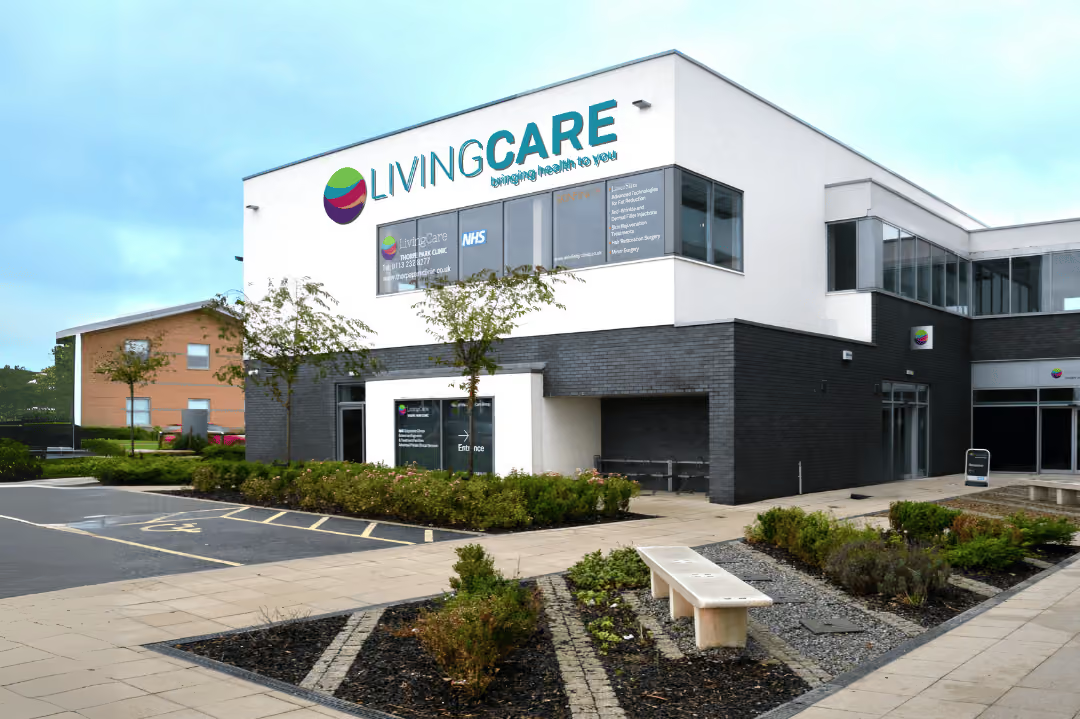
LivingCare offers rapid access to spine pain treatment in Sheffield and spine pain treatment in Leeds, with consultant-led care at modern facilities: Thorpe Park Clinic, Leeds and Canon Medical Arena, Sheffield. Treatment is available self-pay or with private medical insurance. If needed, we can also arrange a private GP consultation and referral to support your care pathway.
To talk your options through first, book a Pain Management Consultation, or see everything our Pain Management team offers.

Dr Ganesan Baranidharan
Consultant in Anaesthesia and Pain Medicine
The table below has multiple columns and can be scrolled horizontally on smaller screens. When viewing on mobile, this table is best viewed in landscape format.
“Fantastic service from start to finish. Lovely staff. Surgeon was amazing, explained everything in detail and the procedure odcortisone injection to the lower spine relatively pain free. Thank you 😊”
Chris Booth
05
October 2026


You can self-pay for treatment at LivingCare or use your medical insurance. Click here to learn more.


We're always on hand, so get in touch and we'll get back to you straight away.
Speak to our teamYou can receive this treatment at any one of the locations below.


Your healthcare journey in 4 easy steps
Get in Touch
Call us on Leeds 0113 2494655 or Sheffield 0114 7005811 or use our online booking form to send your enquiry. Let us know your preferred appointment type, either virtual or face to face, and we will work to find a time that suits you.
We Arrange Your Appointment
If you filled out our online booking form, one of our team will contact you within 2 hours with available appointment options. Once your appointment is booked, you will receive an email confirmation with all the details you need.
Attend Your Appointment
Attend your appointment at your chosen time, either virtually or in person, with one of our highly qualified consultants. If your appointment requires a written report, this will be prepared and sent to you within 48 hours.
Aftercare and Follow-Up
If you need any further tests, treatment or follow-up, we will help arrange these for you. If you require a copy of your report or images, please let us know and we will send these promptly.
Your healthcare journey in 4 easy steps
Get in Touch
Call us on Leeds 0113 2494655 or Sheffield 0114 7005811 or use our online booking form to send your enquiry and we will work to find a time that suits you
We Arrange Your Appointment
If you filled out our online booking form, one of our team will contact you within 2 hours with available appointment options. Once your appointment is booked, you will receive an email confirmation with all the details you need.
Attend Your Appointment
Attend your appointment at your chosen time with highly qualified clinicians. If your appointment requires a written report, this will be prepared and sent to you within 48 hours with the option to upgrade to 24 hours.
Aftercare and Follow-Up
If you need any further tests, treatment or follow-up, we will help arrange these for you. If you require a copy of your report or images, please let us know and we will send these promptly.
You can receive this treatment from one of the consultants listed below.
Explore the various options available for this treatment.

With our self-pay service, there are no waiting lists - consultations are offered within 24 hours, with treatment within a week. All costs, including tests or scans, are quoted upfront with no obligation to proceed. Visit our Prices page for full details.

If using medical insurance, contact your provider to confirm coverage for all treatment stages before your first appointment. You’ll need a referral letter from your GP for a private procedure at The LivingCare Group. Once you have it, either you or your GP can book your first appointment with us.


